


 Directory
Thesis defense: Hisoilat Bacar
| When |
Oct 24, 2025
from 02:00 to 05:00 |
|---|---|
| Where | Salle Condorcet |
| Contact Name | Hisoilat Bacar |
| Attendees |
Dr. Marie Bréau, Inserm, Sorbonne Université, France; Dr. Alexander Nyström, Université de Fribourg, Allemagne; Pr. Violaine See, Université Claude Bernard Lyon 1, France; Dr. Julie Batut, CNRS, Université Paul Sabatier, France; Dr. Florence Ruggiero, CNRS, ENS de Lyon, France, Directrice de thèse; Pr. Nicolas Goudemand, ENS de Lyon, France, Co-directeur de thèse; Dr. Marilyne Malbouyres, CNRS, ENS de Lyon, France, Invitée; Dr. Josselin Breugnot, Responsable Unité Data Science & Technologies, SILAB, France, Invité. |
| Add event to calendar |
 vCal
vCal iCal
iCal
|
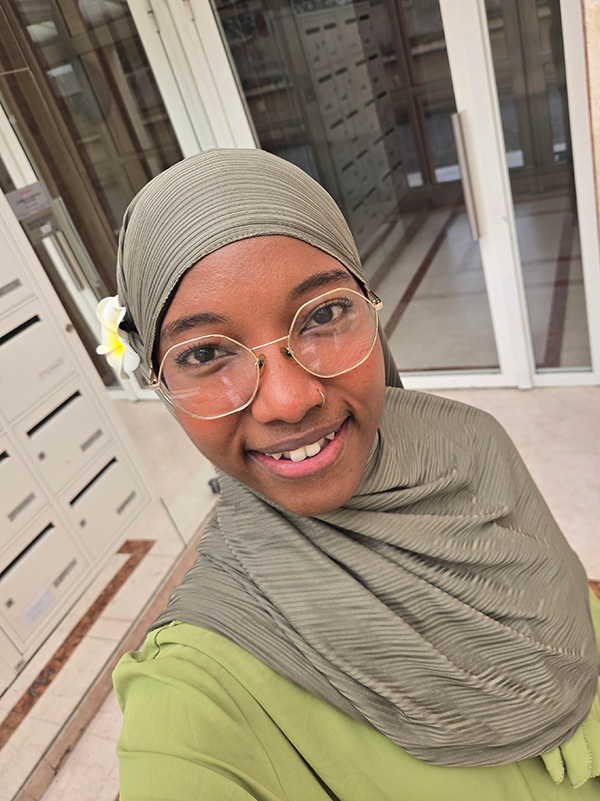
On October 24th, Hisoilat Bacar of the team of Florence Ruggiero will support her thesis entitled:
"Zebrafish as a real-time model system to study skin regeneration dynamics and extracellular matrix remodeling"
Abstract:
Wound healing in mammals is a complex, multi-step process involving hemostasis, inflammation, re-epithelialization, granulation tissue formation, and dermis remodeling. In humans, this process often results in scar formation because the dermis does not fully remodel. To better understand and potentially improve healing outcomes, we are exploring zebrafish, a small vertebrate, as an alternative model. Zebrafish exhibit remarkable regenerative abilities, including the regeneration of the retina, kidney, heart, and caudal fin. Their small size and optical transparency during larval stages, availability of fluorescent transgenic lines and permeability to small molecules make them ideal for real-time studies of skin repair and bioactive compound testing.
To analyze the dynamics of skin repair in 4 days-post-fertilization larvae, we developed a reproducible in vivo laser-induced skin injury protocol in larvae using a spinning-disk confocal microscope coupled with a UV laser. We utilized the Tg(krtt1c19e:egfp; lyndtomato) transgenic line, which labels basal keratinocytes with green cytoplasm and red plasma membranes. This technique allows precise control over the shape, size and depth of the wound. Using this approach, we identified five rapid and reproducible phases of re-epithelialization from time-lapse movies. During this process, basal keratinocytes undergo morphological changes, forming a characteristic rosette that closes the wound, which resorbs over time. Using Lifeact-GFP labeling, we monitored actin cytoskeleton dynamics, revealing the initial formation of an actin ring, followed by the mobilization of ‘leader’ cells by extending lamellipodia, while ‘follower’ cells exhibit cryptic lamellipodia. Image segmentation and cell tracking, combining Cellpose and Trackpy, demonstrated active basal keratinocyte migration from the rear of the wound and return to their initial positions. Next, using an existing ‘vertex’ model, we simulated rosette formation to model the initial step of re-epithelialization. Our analysis identified three key parameters influencing this process, which we integrated into a model of cell-cell interactions.
We then characterized immune cell recruitment using the Tg(mpx:egfp) and Tg(mfap4:mCherry) lines to visualize neutrophils and macrophages, respectively and time-lapse imaging. Neutrophils were rapidly recruited, as the wound closes, while macrophages appeared later and persisted at the injury site for up to eight hours. Interestingly, in col14a1-null larvae, neutrophil recruitment is significantly delayed, confirming previous findings reported in rat models.
Immunofluorescence analyses revealed the formation of granulation-like tissue rich in type I and XII collagens, as well as tenascin-C, with a thickening of the dermis and the presence of blood vessels observed using the transgenic line Tg(fli1:egfp). This granulation-like tissue persists for several days post-injury, suggesting a healing mechanism similar to that of mammals, yet leaving no visible scars.
Finally, we implemented a protocol to test small molecules using our laser-induced injury method. After developmental toxicity assessments, we screened a well-characterized bioactive compound provided by our partner to evaluate its effect on wound-closure speed. These experiments validate zebrafish as a reliable model for screening bioactive molecules.
Overall, our findings lay the groundwork for further studies on the mechanisms of scar-free healing and confirm the relevance of zebrafish and laser-injury method for wound-healing research.