Directory
Thesis defense: Baptiste Alberti
| When |
Nov 05, 2025
from 02:00 to 05:00 |
|---|---|
| Where | Salle des thèses |
| Contact Name | Baptiste Alberti |
| Attendees |
Robin Andersson – Rapporteur – Associate Professor of Bioinformatics, Copenhagen University; Anamaria Necsulea – Rapportrice – Chargée de Recherche CNRS, LBBE; Olivier Gandrillon – Examinateur – Directeur de Recherche CNRS, LBMC; Arnau Sebe-Pedros – Examinateur – Group Leader, CRG, Barcelona; Marie Sémon – Examinatrice – Professeure à l’ENS de Lyon, LBMC; Yad Ghavi-Helm – Directrice de Thèse – Directrice de Recherche CNRS, IGFL; Paul Villoutreix – Co-Encadrant (membre du jury invité) – Chair de Professeur Junior INSERM, MMG, Marseille. |
| Add event to calendar |
 vCal
vCal iCal
iCal
|
On November 5th, Baptiste Alberti of the team of Yad Ghavi-Helm will support his thesis entitled:
"Develop bioinformatics tools to reconstruct the three-dimensional spatio-temporal activity of enhancers during Drosophila melanogaster embryogenesis"

Abstract:
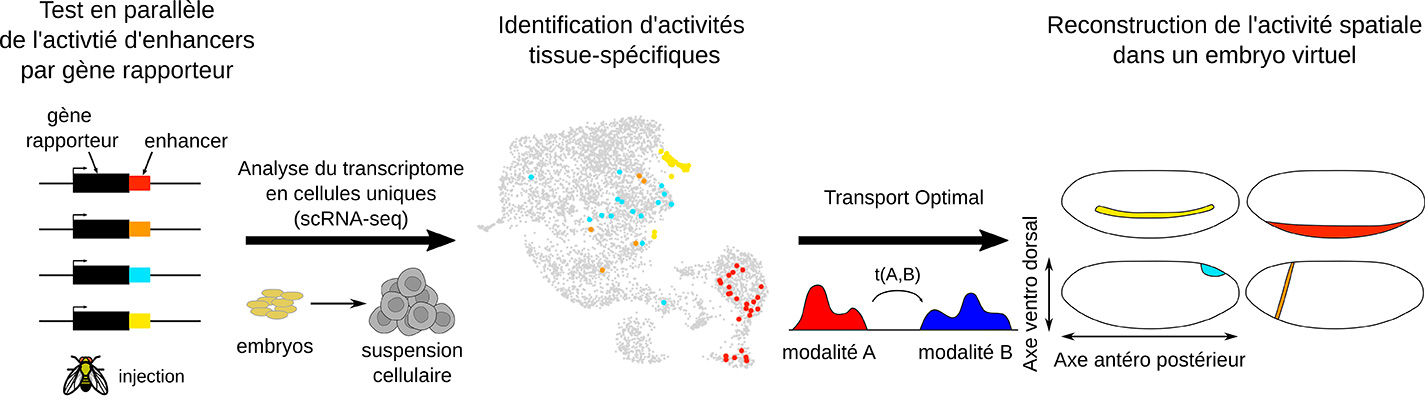
The regulation of gene expression at the transcriptomic level plays a central role in cell fate determination and development. Key regulatory elements, known as cis-regulatory modules (CRMs), fine-tune gene expression in response to biological cues or environmental signals. My thesis focused on one type of CRM: enhancers, which are non-coding DNA elements that regulate their target gene expression in a precise spatial and temporal manner. My aim was to develop a method to map this activity at the single-cell level in a scalable manner. Indeed, recent technological advances have improved the ability to predict the location of enhancers, but identifying their spatial and temporal activity remains challenging. Current enhancer-reporter assays either lack throughput or fail to capture spatial and temporal resolution. To address this, we developed spatial-scERA, a method that combines parallel enhancer-reporter assays with single-cell RNA sequencing (scRNA-seq) and spatial reconstruction. Our approach leverages optimal transport to position the cells from a scRNA-seq experiment in a virtual reconstruction of the embryo by integrating the transcriptomic profiles of these cells with a priori knowledge on the expression of a set of marker genes. This enables enhancer activity to be mapped in a reconstructed 3D virtual tissue at single-cell resolution. To validate spatial-scERA, we applied it to predict the spatial activity of 25 candidate enhancers in a stage 6 Drosophila embryo. Our dataset included both well-characterized and unannotated enhancers, allowing us to assess the method’s accuracy while uncovering new regulatory elements and their activity. By systematically comparing our reconstructions with HCR in-situ imaging, we confirmed that spatial-scERA accurately reconstructs enhancer activity patterns, even for enhancers whose sequence was recovered in as few as 10 cells in the scRNA-seq experiment. We further showed that integrating spatial information allows for enhancer target gene predictions and improves scRNA-seq cluster annotation, enabling more precise cell-type identification. To extend our method to other developmental stages, we further generated and analyzed spatial-scERA datasets from stages 8 and 11 of Drosophila embryogenesis, tracking the same 25 enhancers across development. We first investigated the dynamics of enhancer activity across cell types and stages from scRNA seq alone, focusing on observing tissue-specificity variations across stages. However, in order to generate 3D reconstructions of the enhancers’ activity, we currently lack a 3D atlas of markers genes expression at these stages. To generate this atlas, we are developing image-based spatial transcriptomics using the MERFISH technology at the Spatial-Cell-ID facility. Once this data will be available, we will be able to generate our own reconstructions at different stages, and thus, project our enhancer from scRNA-seq to spatial position in an embryo. Overall, our approach provides a powerful framework for mapping the spatial and temporal evolution of enhancer activity across tissues and developmental stages. This method is broadly applicable to any organism compatible with enhancer-reporter assays and scRNA-seq, offering new insights into gene regulation in complex multicellular systems.