


 Directory
Thesis defense: Juan Ren
| When |
Sep 22, 2025
from 01:30 to 04:30 |
|---|---|
| Where | Salle des thèses |
| Contact Name | Juan Ren |
| Attendees |
Rapporteure: Ana GUADAñO-FERRAZ, Chercheuse, Université Autonome de Madrid; Rapporteure: Sylvie REMAUD, Maîtresse de conférences HDR, Muséum National d'Histoire Naturelle; Examinateur: Steffen MAYERL, Chercheur, Université de Duisbourg; Examinatrice: Isabelle DUSART, Directrice de recherche, Sorbonne Université / CNRS; Examinatrice: Nathalie DAVOUST-NATAF, Professeure des universités, Ecole Normale Supérieure de Lyon; Directeur de thèse: Frédéric FLAMANT, Directeur de recherche, Ecole Normale Supérieure de Lyon / INRAE; Directeur de thèse: Jiemin WONG, Professeur, East China Normal University; Co-directrice de thèse: Sabine RICHARD, Chargée de recherche, Ecole Normale Supérieure de Lyon / INRAE. |
| Add event to calendar |
 vCal
vCal iCal
iCal
|
On September 22nd, Juan Ren of the team of Frédéric Flamant will support her thesis entitled:
"Influence of thyroid hormones on the maturation and function of parvalbumin neurons in the mouse neocortex"

Abstract:
Thyroid hormones are crucial for brain development, particularly for the maturation of parvalbumin neurons, key players in maintaining the brain's excitation/inhibition balance. Our research on the mouse brain shows that thyroid hormones act as a temporal trigger, essential during the first three postnatal weeks for parvalbumin neuron development. While not entirely necessary in these neurons after this period, thyroid hormones help maintaining parvalbumin neuron function throughout life. Disruptions in thyroid hormone signaling lead to altered gene expression, impacting neuronal excitability, resulting in behavioral deficits like hyperactivity and increased seizure susceptibility. This highlights the lifelong importance of thyroid hormones in maintaining healthy brain function and suggests potential therapeutic targets for neurological disorders like epilepsy and autism.
甲状腺激素对大脑发育至关重要,尤其是对parvalbumin神经元的成熟起着关键作用,这些神经元在维持大脑兴奋/抑制平衡方面发挥着关键作用。我们对小鼠大脑的研究表明,甲状腺激素起到了时序开关作用,出生后的前三个星期对parvalbumin神经元的发育至关重要。虽然在此之后这些神经元并非完全依赖甲状腺激素,但甲状腺激素有助于维持parvalbumin神经元在整个生命过程中的功能。甲状腺激素信号传导的紊乱会导致基因表达的改变,影响神经元的兴奋性,从而导致行为缺陷,如过度活跃和增加的癫痫易感性。这突显了甲状腺激素在维持健康大脑功能方面具有长远的重要性,并为诸如癫痫和自闭症等神经疾病提供了潜在的治疗靶点。
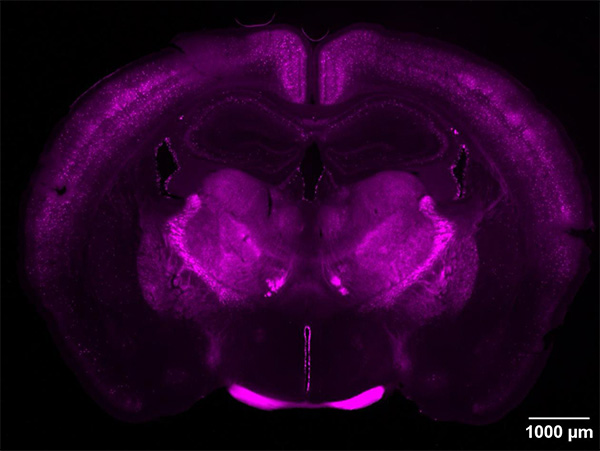
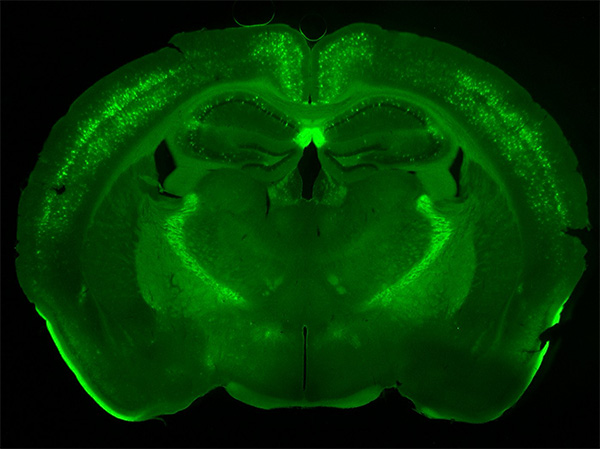
Image from one mouse brain slice. Left: Parvalbumin neurons genetically labeled by Tomato. Right: Perineuronal nets labeled by WFA staining.